
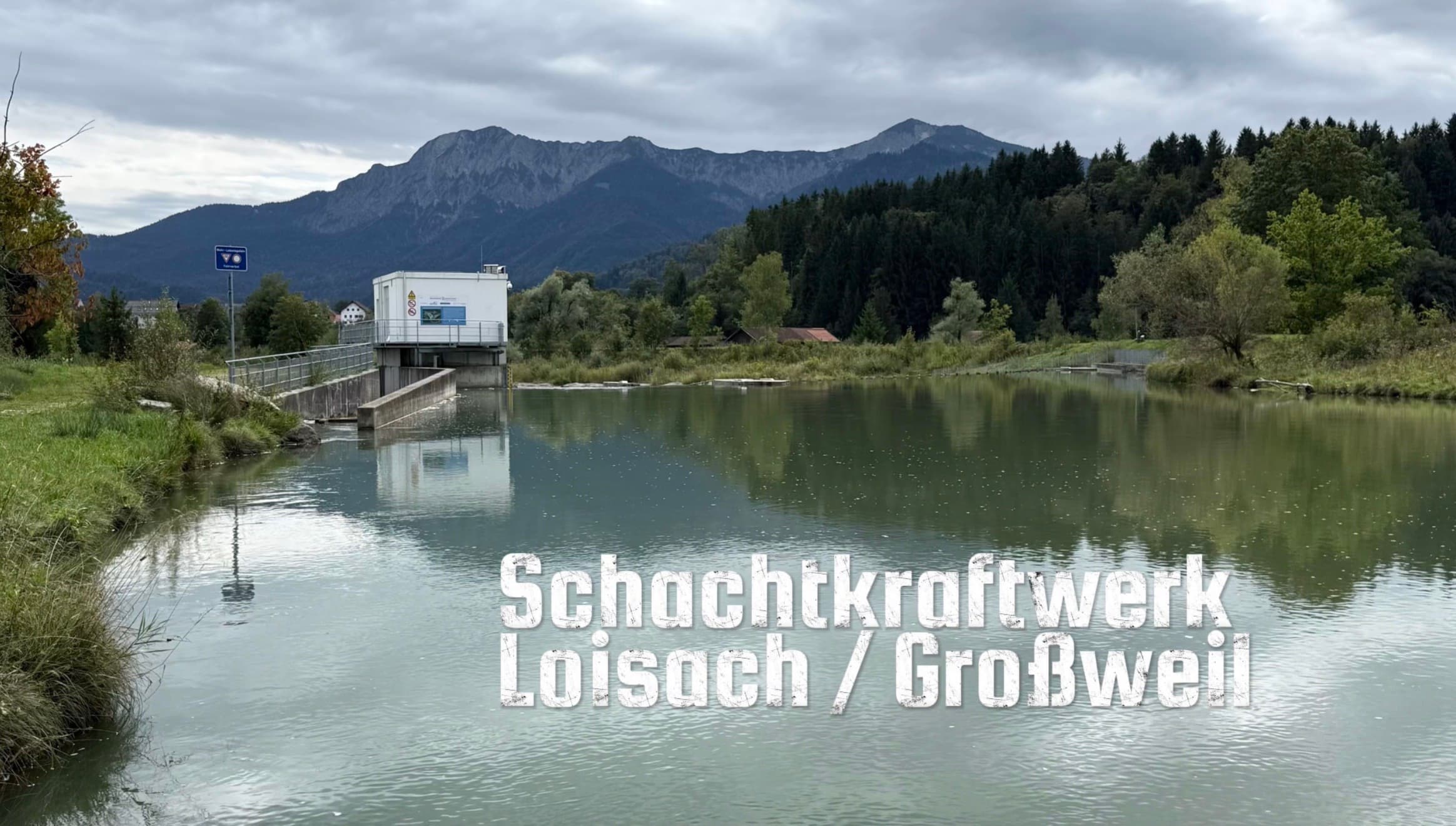
1. A power plant with a particular claim
On 18 September 2026 we visited the plant together with Dr Joachim Pander, who was involved in its scientific investigation. The results are documented in a report by the Bavarian Environment Agency and were subsequently published in a peer-reviewed journal.[1][2]
The shaft hydropower concept was associated with potential advantages for fish protection and ecological connectivity. The Großweil investigations show, however, that these theoretical advantages were not fully realised at this particular site.
The 2023 assessment by Josef Knott, Melanie Mueller, Joachim Pander and Jürgen Geist identified a need for optimisation.[2] It examined, among other issues, fish passage and fish injury as well as changes in habitat and the aquatic community.
Different mortality values were observed under particular tested conditions and for particular species. The highest published individual value was up to 44 per cent. This is not a general mortality rate for the plant.[1][2]
2. A power plant in a European protected area
The plant was approved in a Natura 2000 site. In early 2016, the Technical University of Munich reported on the approval of the pilot plant; one reason given was that it would be built at an existing barrier and could improve fish connectivity.[3] In 2020, TUM again highlighted the strict ecological criteria associated with the approval.[4]
During the site visit on 18 September 2026, Pander expressed a markedly different professional assessment: he said he could not understand why this plant had been approved in an FFH/Natura 2000 site at all.
This is Pander’s current professional assessment. It is not evidence that the original approval was unlawful.
What happens to an approval when later empirical findings become relevant to ecological assumptions on which that approval was based?
The administrative records now reviewed show that ecological uncertainty was not introduced into the case only later. The 2014 approval already contains an adaptive mechanism: if the positive ecological forecast is not achieved, remedial and precautionary measures are to be derived, and measures recognised as effective are to be ordered by the District Office in an appropriate form and within an appropriate period.
Following an action challenging the approval by BUND Naturschutz in Bayern and the Bavarian Fisheries Association, this architecture was further specified in 2016. The supplementary decision of 29 November 2016 expressly records that, at the oral hearing before the Munich Administrative Court on 5 February 2016, the parties — with the consent of the joined applicants — agreed on more detailed fish-protection rules. The dispute was then jointly declared resolved.
The supplementary decision defines, among other things, mortality thresholds of 5 per cent for bullhead and huchen and 10 per cent for the remaining fish species. Where a significant impairment is found, the operators must respond in an appropriate manner; the decision lists specific technical and operational options and requires expert verification of effectiveness.
3. Science does not end with the final report
Pander reported during the site visit that the scientific team had proposed concrete improvements and presented findings at a hearing at the Garmisch-Partenkirchen District Office. According to his recollection, individual modifications followed.
Those statements can now be compared with the administrative record. The files confirm that the impact chain was indeed built into the regulatory architecture and that the scientific investigations were followed by further work by the specialist authorities.
The decisive question has therefore shifted. It is no longer whether monitoring or adaptive action existed at all. Both were provided for. The question is how quickly and how bindingly later findings are translated into concrete measures.
4. From monitoring to adaptive action
The specialist-authority statements of 3 February 2026 are central to this question. The water management authority concludes that adequate fish protection within the meaning of the water-law approval has not yet been demonstrated and that remedial action is necessary. The nature-conservation authorities describe individual measures as “mandatory” and state that significant effects on FFH conservation interests cannot be excluded with sufficient certainty in the absence of effective countermeasures.
On 5 March 2026 it was agreed with the operator that possible measures would be identified and examined. According to the District Office’s information of 5 October 2026, the resulting package of measures had not yet been submitted by that date. No specific submission deadline had deliberately been set. The authority stated that its adaptive decision would follow once the concept had been submitted.
At the same time, the District Office stated that it was in regular contact with the operator and that the state of the procedure was described — without naming a specific date — as “well advanced”.
This does not by itself establish unlawful administrative inaction. A technically robust package of measures may require fact-finding, comparison of alternatives and coordination. What remains open is which concrete intermediate steps have been completed since March, what the description “well advanced” is based on, and whether individual measures already identified by the specialist authorities as necessary are ripe for decision independently of an overall concept.
When does a learning approval regime become binding enforcement — and how can the phase between knowledge and decision itself be prevented from becoming a protection gap?
5. What if one power plant is not alone?
A river does not consist of individual approval procedures. Hydropower plants, weirs and other barriers may follow one another, alongside changes to banks, flow, sediment, temperature, habitats and tributaries.
To Pander’s knowledge, the cumulative effect of several hydropower installations on the Loisach as a river system has not yet been investigated. We continue to check whether such studies exist.
Cumulative hydropower impacts are an established international research field. The open question here is narrower: whether such an assessment already exists for the Loisach in science, river-basin planning, water-management concepts or administrative evaluations.
6. The river does not know project boundaries
Which existing institutions bring together knowledge about individual interventions along the Loisach — and who examines what their cumulative effects mean for the ecological functioning of the river as a whole?
Water management, conservation authorities, specialist agencies, municipalities, science and associations already perform many functions. Großweil in fact shows that monitoring, specialist-authority review, association involvement and adaptive mechanisms are institutionally provided for. It would therefore be wrong to infer an institutional void too quickly from this case.
7. A voice for the river — but only where a function is missing
Institutional representation of the Loisach would be poorly designed if it merely created another environmental organisation or parallel administration. Where existing institutions already perform a function reliably, that function should not be duplicated.
Großweil therefore does not prove that the Loisach needs a river council, guardian or other new institution. The case allows a more precise test: do existing institutions absorb new knowledge, compare it with the original requirements, make timely decisions, implement adaptive measures and verify their effectiveness?
8. Science produces knowledge. Institutions must continue working with it.
Science can measure, observe, compare and make uncertainty visible. It does not automatically decide what happens next. Institutions must absorb findings, review decisions, adapt where necessary and later ask whether those adaptations worked.
Großweil shows an unusually clearly documented learning cycle of law: risks were recognised, monitoring was agreed, thresholds were defined and adaptive action was provided for. The current question is therefore no longer primarily whether law can learn, but whether it translates its own learning into binding enforcement in time.
The Loisach does not end at the boundary of an approval notice — but a learning approval notice does not end with the monitoring report either.
9. Sources and transparency
- LfU/TUM (2022): Fischökologisches Monitoring an innovativen Wasserkraftanlagen – Band 10: Großweil an der Loisach.
- Knott, J.; Mueller, M.; Pander, J.; Geist, J. (2023): Ecological assessment of the world’s first shaft hydropower plant. Renewable and Sustainable Energy Reviews 187, 113727.
- Technische Universität München (2016): Ein Kraftwerk, das sich versteckt – Genehmigung der Pilotanlage Großweil im Natura-2000-Gebiet.
- Technische Universität München (2020): Erstes Schachtkraftwerk am Netz.
- Technische Universität München (2023): Wasserkraftwerke umweltfreundlicher machen – ökologische Auswirkungen des Schachtkraftwerks Großweil untersucht.
- Garmisch-Partenkirchen District Office: water-law approval and planning decision of 18 December 2014; primary administrative source supplied in response to the environmental-information request.
- Garmisch-Partenkirchen District Office: supplementary decision of 29 November 2016; primary administrative source.
- Garmisch-Partenkirchen District Office: amendment and supplementary decision of 21 August 2018; primary administrative source.
- Hycor Ecohydraulics: assessment of plant-related mortality at the Großweil hydropower plant, 31 October 2023.
- Effectiveness review of structural measures at the Mühlbach, 2 December 2024.
- Garmisch-Partenkirchen District Office: Großweil hydropower plant — statements of the specialist authorities, 3 February 2026.
- Information provided by the Garmisch-Partenkirchen District Office on the status of adaptive action, 5 October 2026.
- Primary material: site visit, conversation and documentation, 18 September 2026; not publicly available online.
The administrative-file review of the core Großweil material has been completed for the points presented here. Still open are, in particular, the concrete timetable and package of adaptive measures, individual procedural records relating to the 2016 court settlement, and the question whether a Loisach-specific cumulative-impact assessment exists. Open questions are not presented as established facts.