
Resonance · Restoration · Climate disruption · Learning law
When Ecological Conditions Change
The EU Nature Restoration Regulation as a Test for Learning Law
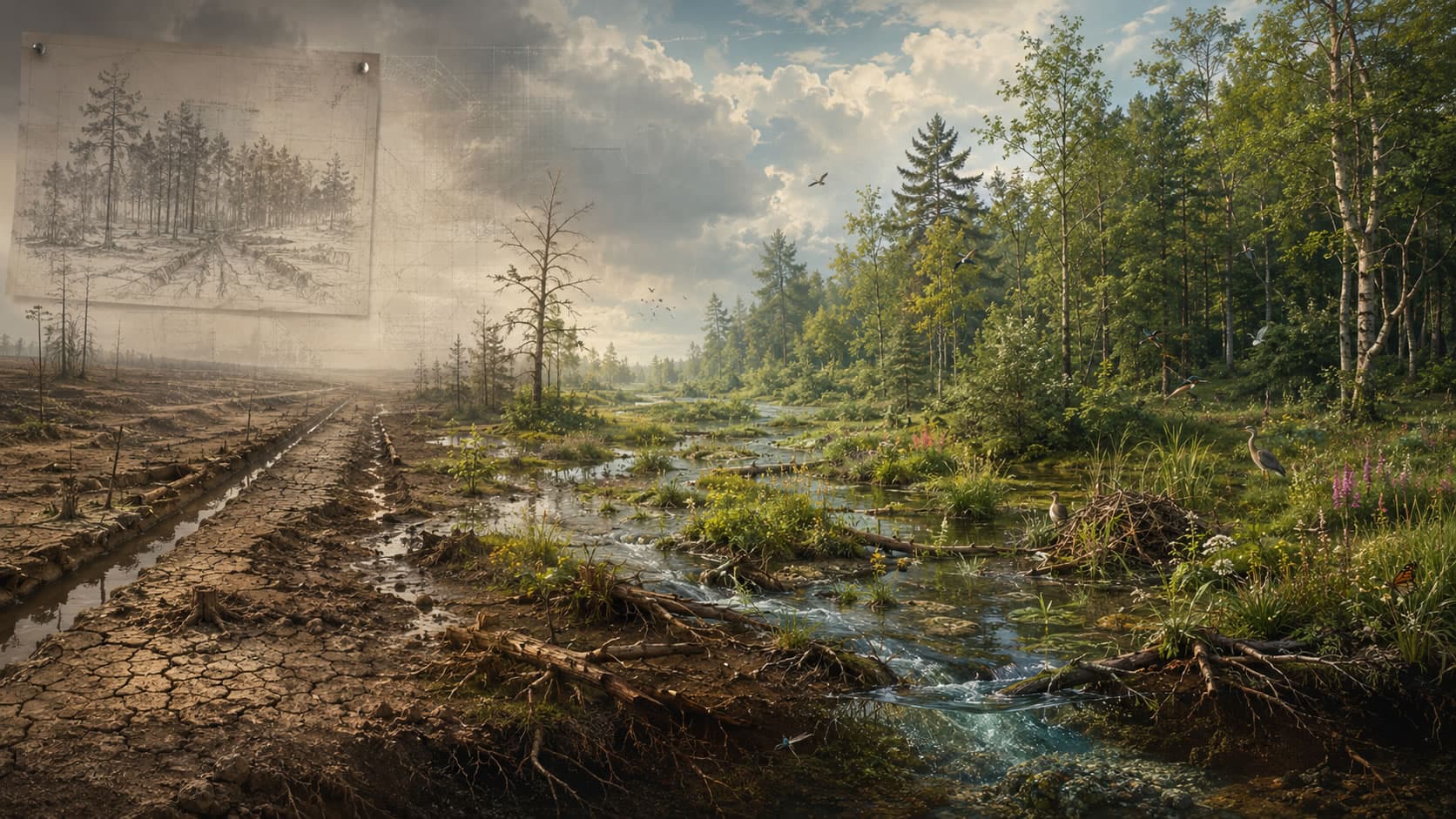
Restoration under changing conditions: the question is not only which historical target image should be reproduced, but whether hydrology, soils, connectivity and other supporting ecological conditions enable ecological processes to sustain themselves again. AI-generated editorial illustration; not a documentary image of a specific site.
The European Union wants to restore nature. But what exactly is the condition to be restored?
The question sounds simpler than it is. Restoration presupposes an ecological frame of reference: a forest type, a peatland, a river, a floodplain or another habitat characterised by particular structures, species and functions. Yet accelerating climate disruption is increasingly altering the very site conditions under which such reference states developed.
This creates a conflict that reaches far beyond forestry policy. What happens when a legally protected or restoration-dependent habitat comes under long-term climatic pressure at a particular site? Must the law continue to hold to the existing target? May that target be changed? And if so, at what point, on what scientific basis and subject to which safeguards?
Before answering that question through an individual example such as European beech, it is worth taking one step back. What does the Regulation itself mean by restoration? Does it require the reconstruction of a historical ecological picture — a kind of museum island — as Jens Jacob suggests? Or does it point to something else: supporting a degraded ecosystem in such a way that the underlying conditions needed for autonomous ecological development can recover, much as a rewetted peatland can resume its own trajectory once its hydrology has been restored?
That distinction shapes the entire debate. It helps determine whether success is measured only against a fixed historical picture or also against restored ecological functionality, resilience and the capacity for self-directed development.
A politically sharpened conflict
The debate surrounding the EU Nature Restoration Regulation shows how quickly this issue becomes politically charged. In a guest article published by Frankfurter Allgemeine Zeitung on 15 August 2026, Jens Jacob, head of the forestry department in the Rhineland-Palatinate environment ministry, criticised what he sees as an overly historical understanding of forest restoration under climatic conditions that may no longer support the same forest communities.
One of his central examples refers to modelling by the Forest Research Institute of Baden-Württemberg. Under an RCP 8.5 scenario, the potential distribution of beech and mixed beech forests in Germany could, according to that modelling approach, fall from around 74 per cent to roughly 8 per cent by 2070. Jacob uses this to argue that conservation law must not become a “museum island” that freezes historical forest communities under altered climatic conditions.
The criticism points to a real tension. But it does not fully capture the extent to which the Nature Restoration Regulation already incorporates climate projections, monitoring and revision into its legal architecture.
The Regulation is less static than its critics suggest
The Nature Restoration Regulation is not a law for the mechanical reconstruction of historical nature images. Its legal concept of restoration is functional. Structure, functions, biodiversity, ecological integrity, stability and resilience are central elements. Just as importantly, when determining favourable reference areas and suitable restoration areas, Member States must take account not only of historical distribution but also of projected environmental changes, including those linked to climate change.
Member States are expected to base their plans on current scientific knowledge, take climate scenarios into account, monitor implementation and revise measures where effectiveness is insufficient. The Regulation also recognises, in specific legal contexts, habitat changes that are unavoidable and directly attributable to climate change. That does not create a general licence to replace existing conservation or restoration goals without a separate legal assessment. Annex VII further lists assisted migration of provenances and species as one possible restoration measure where climate-related adaptation needs arise.
A central criticism therefore goes too far if it presents the Regulation as requiring blind reconstruction of historical ecosystems. Its restoration obligations remain binding, but they must be implemented in light of evolving scientific knowledge and climate-related evidence. In this respect, the Regulation already contains important elements of what may be called learning law.
A learning architecture is not yet a decision rule
That, however, does not solve the underlying problem.
Germany’s draft National Restoration Plan makes the remaining gap visible. It works with condition data, spatial search areas and geodata. For restoration measures under Article 4, it uses search areas at NUTS-3 level in order to retain flexibility for later specification by the Länder. Climate risks and projections are expressly addressed.
At the same time, the draft itself acknowledges that suitable methods for integrating these risks into planning and implementation still need to be identified and developed. In the section dealing with unavoidable habitat changes directly caused by climate change, the current public draft states: “No information.”
This is where the main operational challenge lies. The issue is not the absence of climate data, nor the absence of planning spaces. What remains insufficiently transparent is a habitat- and site-specific translation rule connecting climate evidence to the choice of measures, the relevant reference area and, where legally permissible, a possible adaptation of the ecological target pathway.
When should a restoration target remain unchanged? When is it sufficient to adjust the measure? When does a different reference area become relevant? And when is the threshold reached at which an existing ecological target pathway itself may have to be altered under legally controlled conditions?
European beech as a stress test
European beech is a useful stress test for this problem, but precision is essential.
The frequently cited shift from around 74 per cent to roughly 8 per cent refers to an RCP 8.5 scenario for climate-dynamic potential natural vegetation. Under RCP 4.5, the modelled potential changes only modestly and remains just under 70 per cent in 2070. More importantly, potential natural vegetation is not the same as actual forest area, not the same as tree-species suitability and not the same as a habitat type protected under the Habitats Directive.
It would therefore be an overstatement to infer from the 74-to-8 figure that Germany’s beech forest habitat types are already ecologically obsolete on a broad scale.
The official German Habitats Directive report for 2019–2024 does not support such a conclusion. In the continental biogeographical region, habitat types 9110 and 9130 are assessed as favourable across the relevant parameters and overall. A contribution in BfN-Schriften 681 reaches a much more cautious conclusion for large-scale beech forest habitat types: the modelling currently available does not provide a sufficiently robust basis for the general claim that favourable conservation status has ceased to be a meaningful objective for these habitats.
That is not a reason for complacency. It shows instead that two errors must be avoided at the same time.
The first would be to take climate risks seriously only once ecological damage has become irreversible. The second would be to abandon existing protection targets prematurely merely because future change is possible.
Uncertainty requires precaution — but not arbitrariness
This is precisely where the precautionary principle becomes important.
Scientific uncertainty is not a reason for inaction in environmental law. Where there are plausible risks of serious or irreversible damage, precautionary measures may be justified before complete scientific certainty has been reached. Monitoring can be intensified, pressures reduced and resilience measures introduced early. Depending on the ecosystem, such measures may include water retention, structural diversity or other reversible forms of adaptation.
But the same scientific uncertainty that may justify early precautionary action cannot automatically justify the permanent abandonment of an existing ecological target pathway.
There is an important asymmetry here: the greater the potential damage and the more irreversible the ecological development, the earlier precautionary action may need to begin. But the more strongly the legal response itself changes or replaces a binding conservation objective, the more robust the scientific justification, alternatives assessment and control mechanisms must be.
For analytical purposes, this logic can be described through four thresholds: early warning, precaution, adaptation and transformation. These are not four new legal stages, not a codified doctrine and not a sequence that can simply be read out of the Nature Restoration Regulation. Comparable graduated approaches to evidence and intervention already exist in precautionary and risk-regulation law. The term “transformation” is used here as an analytical label only, not in the specific sense of the climate-adaptation literature on transformational adaptation.
For ecological reference targets, however, the distinction is useful.
Early warning means that plausible scientific signals trigger stronger monitoring and risk-reduction measures.
Precaution means that serious, scientifically plausible risks may justify preventive and preferably reversible action even without full proof.
Adaptation means that more robust evidence of changed site or system conditions leads to changes in measures and, where legally justified, potentially in the relevant reference area.
Transformation does not mean the free abandonment of a conservation objective. It refers to a legally controlled transition to an alternative ecological target pathway — but only where the applicable nature conservation and sectoral law allow such a transition in the individual case.
That final step requires especially strong safeguards. An alternative target pathway would need its own legal, ecological and scientific justification. It would have to be examined whether the previous target remains achievable or restorable by reasonable means. Alternatives would have to be compared. The decision would need to be documented, monitored and kept open to revision.
What restoration means in legal terms
The Nature Restoration Regulation itself provides an important starting point. Article 3 defines restoration as the process of actively or passively assisting the recovery of an ecosystem in order to improve its structure and functions, with the aim of conserving or enhancing biodiversity and ecosystem resilience. At the same time, the Regulation defines an ecosystem as a complex, dynamic system of communities and their non-living environment interacting as a functional unit.
Restoration is therefore not legally reduced to reproducing a historical ecological picture. It is directed towards the recovery of a functioning and resilient ecosystem.
For this article, “renaturation” is therefore not used as a separate legal concept. It is treated only as shorthand for restoration in this functional sense. As a methodological and functional interpretation developed in this article — not as an additional statutory success criterion — restoration may be understood as supporting an ecosystem, through active measures where necessary and passive assistance where possible, so that the conditions under which it can increasingly develop through its own ecological dynamics are restored or stabilised. Existing legal protection, conservation and restoration objectives remain binding.
This enabling logic also raises a wider social question. In many other fields, autonomy and limited external control are treated as positive values. In nature conservation, however, areas governed by process protection remain comparatively rare.
Germany’s first nationwide assessment of large wilderness areas found that, as of November 2024, existing large wilderness areas covered about 0.62 per cent of the country’s terrestrial land area. Germany’s National Biodiversity Strategy 2030 maintains the target of developing large-scale wilderness areas across at least 2 per cent of the national territory.
The Bavarian Forest National Park demonstrates what process protection can mean in practice. In its natural zones, which cover 75.37 per cent of the park, human intervention is generally excluded under the guiding principle “Let nature be nature.” Yet the same national park also shows why ecological freedom may require prior restoration. Drained peatlands and straightened streams may first need active “start-up assistance” before natural processes can once again become largely self-sustaining.
That example makes the enabling logic tangible: where human intervention has damaged the conditions that support ecological processes, restoration may initially require intervention precisely in order to make later autonomous ecological development possible.
For a forest, such supporting conditions can include hydrology, soil structure, humus, microclimate, spatial connectivity, disturbance regimes and opportunities for natural succession. In peatlands, floodplains and rivers, hydrological dynamics, connectivity, flooding regimes and nutrient or material flows become particularly important.
These conditions are not merely secondary features of a target state. They help determine whether an ecosystem can sustain its essential functions, relationships, resilience and capacity for development.
This leads to an important sequence of reasoning. Before a protected habitat is classified as no longer viable under future climate conditions and an alternative target pathway is considered, it should first be examined whether its supporting system conditions have been impaired by drainage, soil degradation, fragmentation, insufficient water retention or other anthropogenic pressures — and whether those impairments can be reversed or reduced.
Otherwise, there is a risk that human-caused degradation will be misread too quickly as unavoidable climate-driven transformation.
Historical reference states therefore do not become irrelevant. Their function changes. They are not only benchmarks for a desired condition; they are also evidence of the ecological relationships and conditions that have sustained a system. Restoration can then be understood as restoring or stabilising those functional and developmental conditions as far as possible, while observing how the ecosystem actually develops.
This is the external reference point of a legally structured capacity to learn. Law does not learn as an autonomous subject. Learning occurs through legally authorised institutions that can absorb new ecological knowledge, reassess prior assumptions and adjust decisions within defined competences, procedures and evidentiary requirements. The decisive question is whether observations of the real ecosystem can feed back into legal categories, reference assumptions and expectations about ecological targets without dissolving their binding force into discretion.
What learning law must be able to do
This is more than a technical question of forestry. It is a fundamental issue for modern legal governance under conditions of accelerated ecological change.
Law often works with categories, states and thresholds that presuppose a degree of stability. Ecological systems are dynamic. Under accelerating climate disruption, that dynamism becomes stronger and can in some cases become directional and persistent.
A legal system that relies exclusively on static reference images may eventually steer past real ecological conditions. A legal system that makes reference states freely flexible, by contrast, loses binding force and opens the door to opportunistic downward adjustment of protection goals.
The viable alternative is therefore a legally bounded process of learning and feedback — referred to here, in shorthand, as learning law.
The agents of learning remain people and legally authorised institutions; technical systems, including AI, may support analysis and review but cannot by themselves legitimate a normative change of ecological targets.
The term does not imply autonomous agency on the part of law. It denotes an institutionalised capacity to process new knowledge within legally defined procedures. Learning law does not mean that legal norms become non-binding or that every conservation problem dissolves into open-ended management. On the contrary: precisely because ecological objectives remain binding, the legal system needs transparent rules for translating new scientific knowledge into decisions.
Four levels are especially important.
First, observation and scientific updating are required. Monitoring, climate projections, condition assessments and research must not only record ecological state; they must also make visible which system conditions support or impair ecological functionality and developmental capacity.
Second, restoration requires a functional level of assessment. Where supporting conditions such as hydrology, soils, connectivity or ecosystem dynamics have been degraded, the first question should be whether and how those conditions can be restored before a shift in target is treated as the answer to changing environmental conditions.
Third, institutionalised feedback is required. Measures must be assessed for effectiveness, and plans must be capable of revision where new evidence emerges or where objectives are not being met. The Nature Restoration Regulation already contains a comparatively developed architecture of monitoring, reporting, periodic review and event-triggered revision.
Fourth, transparent decision criteria are needed to determine what kind of evidence should trigger what kind of legal consequence. This is currently the most important area for further development.
The Regulation’s graduated area-based obligations can also be viewed through this lens. For Annex I habitat types that are not in good condition, restoration measures must by 2030 cover at least 30 per cent of the total area concerned. By 2040, the relevant threshold is at least 60 per cent, and by 2050 at least 90 per cent of the area of each group of Annex I habitat types not in good condition.
These remain binding quantitative minimum requirements. Alongside them, however, a complementary functional question arises when assessing the effects of restoration measures: what is actually being achieved on those areas?
It is necessary to observe whether ecosystem structure and functions improve and — as a methodological impact question developed in this article — whether supporting conditions are re-established under which ecological processes can increasingly become self-sustaining.
This functional perspective does not replace the area targets, does not replace the legal benchmark of good condition and does not create an additional statutory success requirement.
Not static — but not finished either
The Nature Restoration Regulation is therefore neither a rigid reconstruction framework nor already a complete model of adaptive conservation law. It is something more interesting: a legal framework that already institutionalises learning processes, but whose concrete translation of climate knowledge into target and measure decisions still requires further development.
For Germany’s draft National Restoration Plan, this means that the decisive work does not begin only with the selection of areas. It begins with the question of how climate risk, site development, ecological function and legally binding objectives are connected.
The resulting logic must lead neither to deregulation nor to ecological immobilism.
As a methodological guideline, the sequence should therefore be as follows: first identify the supporting ecological system conditions and, where they have been anthropogenically impaired and remain restorable, stabilise or restore them. As long as there is no robust evidence that a protected habitat will no longer be viable or restorable at a site even under restored or best-achievable stabilised conditions, its conservation and restoration objective remains in place. Plausible risks must nevertheless trigger early precautionary action.
Only where the relevant system conditions have demonstrably and durably changed, and where the previous target conditions can no longer be recreated despite reasonable restoration efforts, should adaptation of the reference area or a legally controlled alternative target pathway come into consideration.
Climate disruption therefore does not make ecological reference states meaningless. It changes the conditions under which law may legitimately use them.
The central question for the future is no longer only: What condition do we want to restore?
It is also: Under what conditions may we recognise that the same ecological condition at the same place may no longer represent the same legally meaningful target pathway — and how do we prevent that recognition from becoming an excuse for less protection?
That is where the actual learning capacity of nature conservation law will be tested.
Sources and further reading
Regulation (EU) 2024/1991 on nature restoration
European Commission, 1 September 2026 – EU countries submit draft national restoration plans
Draft German National Restoration Plan, April 2026
German Federal Agency for Nature Conservation – Habitats Directive Report 2025
BfN-Schriften 681 – Natura 2000 forest habitat types under climate change
Forest Research Institute of Baden-Württemberg – climate-dynamic potential natural vegetation
Jens Jacob, guest article in Frankfurter Allgemeine Zeitung, 15 August 2026
European Commission Communication COM(2000) 1 on the precautionary principle
DBU – assessment of large wilderness areas in Germany
German Federal Agency for Nature Conservation – wilderness areas in Germany
Nationwide wilderness assessment 2024
Germany’s National Biodiversity Strategy 2030
Bavarian Forest National Park – natural zones / “Let nature be nature”
Bavarian Forest National Park – restoration of peatlands and streams, 12 March 2026
Transparency and licence
AI was used for structuring, alternative formulations, editorial condensation and consistency checks. Sources were reviewed and assessed. Substantive and editorial responsibility is shared by Hans Leo Bader and Helmut Scheel.
This article, including the accompanying AI-generated image, is licensed under Creative Commons Attribution-NonCommercial-ShareAlike 4.0 International (CC BY-NC-SA 4.0).
Structure and parts of the wording were developed with the assistance of AI (GPT, OpenAI). Content responsibility: Hans Leo Bader and Helmut Scheel. (CC BY-NC-SA 4.0)
Image: created in cooperation with AI – generated with ChatGPT Images (OpenAI) – licence: CC BY-NC-SA 4.0.
German version · Versión en español · Back to the English homepage