
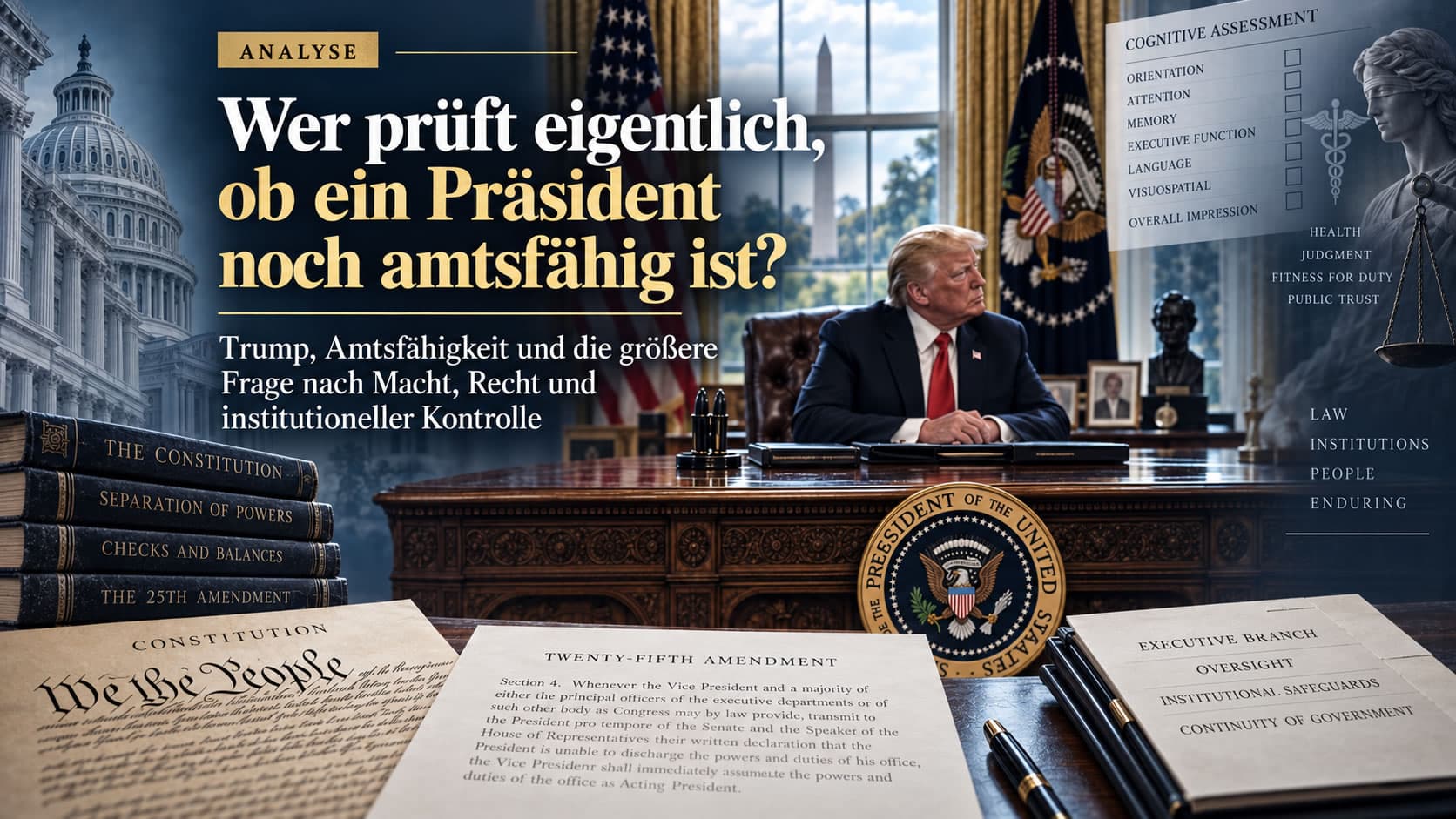
1. Two obvious answers are too simple
Donald Trump’s mental acuity has been the subject of public dispute for years. Behaviour and public appearances are repeatedly interpreted as possible signs of cognitive change. Others regard such conclusions as politically motivated, methodologically unsound or simply unsupported.
The current official medical assessment is unequivocal. After an examination on 26 May 2026, the President’s physician declared Donald Trump fully fit to carry out all the duties of his office. The memorandum published on 29 May described his mental status as normal, his cognitive and physical performance as excellent, and reported a score of 30 out of 30 on the Montreal Cognitive Assessment, or MoCA.
That provides a clear official answer. It has not ended the public debate.
And that is where the more interesting story begins.
Two obvious answers are too simple. The first is that observers can diagnose dementia or another disease from Trump’s public behaviour. There is no sufficient basis for doing that. The second is that a normal screening result and a positive official health report conclusively answer every question about presidential capacity. That would also go too far.
Between remote diagnosis and blanket reassurance lies an institutional question: how does a democracy determine whether the real-world conditions required to exercise very great power still exist?
2. A book asks the diagnosis question — and limits it
Matthias Plügge and Professor Dr Claudia Bader examine this debate at length in their book The Show Must Go On – Die (un)heimliche Demenz des Donald Trump?. The book brings together publicly documented observations, medical and psychological interpretations, and political events, repeatedly asking whether they might indicate cognitive change.
But the book also draws an important boundary. Professor Dr Claudia Bader explicitly states that, as a non-psychiatrist, she cannot make a psychiatric diagnosis and that a clinical diagnosis cannot be derived from public appearances. Observing, describing, comparing and reporting expert assessments is not the same as diagnosing.
For psychiatrists, the American Psychiatric Association’s Goldwater Rule sets a clear ethical boundary: psychiatrists may explain general psychiatric knowledge publicly, but offering a professional opinion about a specific public figure without an examination and proper authorization is considered unethical.
This controversy predates the current book. In 2017 psychiatrist Bandy X. Lee edited The Dangerous Case of Donald Trump, a collection with contributions from 27 psychiatrists, psychologists and other mental-health professionals. The contributors went to different lengths: a review in the Journal of the American Academy of Psychiatry and the Law notes that various diagnostic terms and diagnoses were discussed without agreement on the nature or even the presence of a particular mental illness. At the same time, other contributors stressed that a clinical diagnosis should not be made without a personal examination; a contemporary medical review summarized the book’s position as allowing observed behaviour to inform an assessment of dangerousness rather than a diagnosis. The book therefore became a central case in the dispute over the Goldwater Rule. It does not establish a clinical diagnosis of Trump — but it shows how far the professional debate over remote assessment had already gone by 2017.
That shifts the question. If outsiders cannot responsibly diagnose Trump from a distance, who can make a sufficiently grounded judgment about whether his capacity to serve is impaired?
3. What a MoCA can show — and what it cannot
The official health report provides important counter-evidence. According to the President’s physician, Trump scored 30 out of 30 on the MoCA. That is not a trivial finding and should not be dismissed.
The MoCA is a widely used cognitive screening instrument. It assesses, among other things, memory, attention, language, orientation and visuospatial abilities. A normal score is relevant screening information, although its meaning depends on the clinical context. The test captures certain cognitive functions in a standardized examination; it does not capture every conceivable cognitive change or the full range of functional demands of the presidency.
A screening test is not a complete diagnosis, let alone a constitutional test of presidential capacity. A 2021 Cochrane review examined the diagnostic accuracy of the MoCA for dementia detection. At commonly used thresholds, the authors found high sensitivity but substantially lower specificity and concluded that the evidence was insufficient to make general recommendations about the test’s clinical utility for dementia detection across different settings.
Both extremes are therefore wrong. The MoCA is not worthless, but a score of 30/30 does not establish that every possible cognitive or functional limitation is excluded. Above all, the test alone does not answer the political and constitutional question of whether a president meets all the requirements of the office.
4. The Constitution does provide for presidential inability
The United States does not lack a mechanism for this problem. The Twenty-Fifth Amendment expressly addresses situations in which a president is unable to discharge the powers and duties of the office.
Section 3 allows the president to declare personally that he is temporarily unable to discharge those powers and duties. The vice president then serves as Acting President until the president declares that the inability has ended.
Section 4 addresses the situation in which the president does not make that declaration himself. The vice president and a majority of the principal officers of the executive departments — or another body that Congress may establish by law — may declare that the president is unable to discharge the powers and duties of the office. If the president contests that determination, Congress ultimately decides. For the vice president to continue exercising the powers of the presidency against the president’s objection, two-thirds majorities in both chambers of Congress are required.
This is a real institutional mechanism. It is incorrect to say that the U.S. Constitution has no procedure for presidential inability.
5. Why doctors do not simply decide
Section 4 reveals something important: the Constitution does not tie “inability” to any particular medical diagnosis. Nor does it require regular independent health or cognitive screening of the president.
The procedure is political and constitutional, not medically technocratic.
At first, that can look like a weakness. Why not let an independent medical commission decide? Why is there no fixed procedure that regularly and objectively checks whether the conditions for presidential capacity still exist?
The counter-question is just as important: who protects a democratically elected president from politically instrumentalized medical removal?
The history of the amendment and the Congressional Research Service’s analysis show that Section 4’s high thresholds also serve as safeguards against abuse. The constitutional problem is therefore not simply how to add as much medical control as possible. It is how to protect both governmental capacity and democratic legitimacy.
The text of Section 4 allows Congress to establish another review body by law. According to the current Congressional Research Service position, Congress has not done so. Nor is there a specific statutory definition of “presidential inability”.
Is that a gap — or deliberate constitutional design?
6. From a systemic perspective: a possible institutional updating problem
Presidential capacity is not exclusively a medical category. The practical demands of the office include absorbing information, making decisions, communicating, tolerating stress, directing staff, and exercising political and military responsibility. Medical findings may be relevant to those capacities, but they do not automatically answer the overall question.
Systemic Legal Development examines how law deals with changing factual conditions. One recurring pattern can be described as a possible “institutional updating deficit”: a decision or legal position continues to operate even though its factual basis may have changed, while it remains uncertain whether the institutional system has an adequate procedure for detecting and processing that change in time.
Donald Trump does not prove that such a deficit exists.
On the contrary, the Twenty-Fifth Amendment shows that U.S. constitutional law explicitly recognizes changes in presidential capacity. Its deliberately open category of “inability” can in principle encompass mental as well as temporary or longer-lasting impairments. None of this establishes that such a change has occurred in Donald Trump. His case instead makes visible how difficult an institutional assessment would be when a relevant change is alleged but cannot be medically established from public observations alone.
The narrower question is therefore: how and when is a deliberately political, high-threshold and abuse-resistant mechanism activated when possible changes are gradual, contested and difficult to measure?
An independent medical body might increase confidence — or become a political instrument itself. Greater transparency about health data might improve public oversight — or intrude disproportionately on an officeholder’s medical privacy. Regular testing might reveal changes earlier — or reduce a complex question to a few metrics.
The greater the power attached to an office, and the more its real-world conditions can change over time, the more important it becomes to have a credible procedure capable of detecting, assessing and institutionally processing relevant change.
That principle does not determine what the procedure must look like — or whether the deliberately political design of the Twenty-Fifth Amendment is in fact the appropriate solution.
7. Why the two books belong together — and still do different things
Readers who want to explore the specific Trump debate in greater depth can turn to The Show Must Go On by Matthias Plügge and Professor Dr Claudia Bader. It examines publicly documented observations, medical and psychological interpretations, and the political debate in detail. The book does not make a clinical diagnosis; the boundary between observation and diagnosis is itself central to the discussion.
The book project on Systemic Legal Development begins with the broader question: what must a legal order be able to do when the factual conditions underlying continuing decisions, institutions and positions of power change?
Trump is not proof of such a systemic problem. But he is an unusually vivid case through which the question becomes visible.
Is a democracy designed to detect changes in the conditions underlying its greatest power in time — without itself becoming an instrument of removal?
Sources and interpretation
Core sources include the White House Physician memorandum of 29 May 2026, the Twenty-Fifth Amendment and Constitution Annotated, including its constitutional analysis, the American Psychiatric Association’s Goldwater Rule, Davis et al., Cochrane Database of Systematic Reviews 2021, CD010775, the Journal of the American Academy of Psychiatry and the Law review of The Dangerous Case of Donald Trump, and the contemporary medical review in the British Journal of General Practice.
The official health report is presented here as the published medical assessment of the President’s physician, not as an independent final validation of every dimension of presidential capacity. No diagnosis of dementia or any other specific cognitive disorder is inferred from public observations.
Transparency note
Professor Dr Claudia Bader is the sister of the author, Hans Leo Bader. The Systemic Legal Development book is the author’s own book project. These relationships are disclosed so that the reading recommendations are not mistaken for independent reviews.
AI and responsibility note: AI was used to support research, source structuring, counter-checking and editorial work. AI outputs are not used as factual evidence. Editorial and substantive responsibility remains with Hans Leo Bader.
Licence: Unless otherwise indicated for individual components, this article is licensed under Creative Commons Attribution-NonCommercial-ShareAlike 4.0 International (CC BY-NC-SA 4.0).