
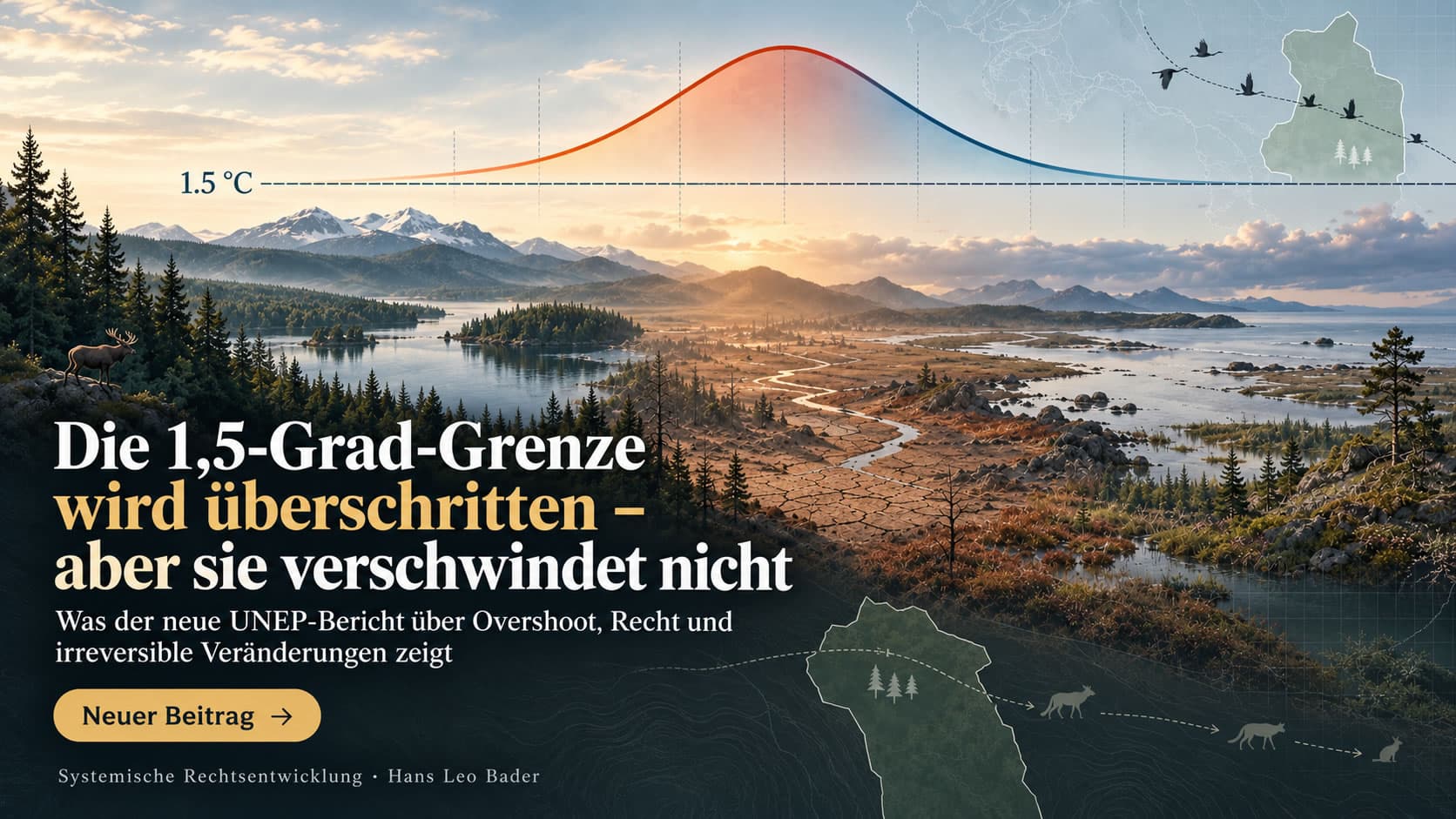
1. The warming level can fall again — lost states do not automatically return
What happens to a limit once it has been exceeded?
One obvious reaction is: then it has simply been missed. A target becomes history, and the exceedance becomes the new normal. For the 1.5°C limit, that would be a dangerous shortcut.
First, it matters what the number means. It is not an absolute temperature. The 1.5°C limit refers to 1.5°C of global warming above the pre-industrial level. Even if the global warming level falls again after a period above that limit, the world does not automatically return to its earlier state.
A vanished glacier does not simply reappear. An extinct species does not return. Coastlines can change permanently. Ecosystems can pass a point after which they function differently than before.
Human decisions can also have effects that last for decades. A road, power plant, settlement or major investment fixes how infrastructure is used and where future money has to go. The longer such structures remain, the harder and more expensive they can be to change.
The global warming level can fall again. Lost states do not automatically return with it.
For long-term decisions, one question is therefore not enough: “Is this assumption correct today?” We also have to ask: “What happens if conditions change — and what may no longer be reversible then?”
2. What the new UNEP report changes
On 2 September 2026, the United Nations Environment Programme (UNEP) published Limiting Overshoot: Navigating exceedance of 1.5°C and pathways towards return. The report addresses a situation that policy now has to prepare for: long-term global warming is likely to exceed 1.5°C above the pre-industrial level.
UNEP therefore examines not only how an exceedance can still be prevented or limited, but also what happens during that period and whether the global warming level could later be brought back to 1.5°C or less above the pre-industrial level.
One unusually hot year with global mean temperature more than 1.5°C above the pre-industrial level is not yet an overshoot. The term means a longer-lasting exceedance of the global warming level. A later return would be far from assured. Greenhouse-gas emissions would have to fall very deeply and remain low. After net zero, more CO₂ would have to be removed from the atmosphere than is still emitted for a sustained period; remaining methane emissions would also have to keep falling.
The central message is therefore: exceeding a limit does not automatically make it obsolete.
The 1.5°C limit does not lose its importance because meeting it becomes harder. At the same time, harm can occur during overshoot that remains even if the global warming level later falls again.
3. Species move — protected areas do not
Nature conservation makes this especially easy to see.
As the climate warms, the ranges of many species shift towards the poles or to higher elevations. Ecological communities change. A protected area, however, stays where it is.
One might therefore jump to the conclusion that if the species for which an area was originally protected become rarer there or disappear, the protection itself loses its purpose.
UNEP rejects that conclusion. A climate-driven change in species composition is not, by itself, a reason to withdraw protection from an area.
A protected area is more than a list of particular species. It can provide refuges, help species move, reduce heat stress, store carbon and connect habitats. Those functions can become more important as the climate changes. UNEP therefore describes protected areas as “climate infrastructure”.
This does not mean every protected area must remain unchanged forever. It means only that change is not automatically an argument for less protection. The first question is which functions the area still performs and which new ones may become important. Which species, habitats and conservation objectives are legally protected continues to depend on the laws that apply to that area.
4. What this means for long-term decisions
This turns a climate report into a broader question: how good is a decision that is meant to last for decades if the conditions on which it rests change during that time?
Planning needs data. Authorities and companies work with maps, measurements, forecasts and assumptions about how an area or system behaves. Without such foundations, decisions would be difficult to review.
The problem is not that those foundations are wrong. The problem is that they can become outdated.
A decision can be based on correct data today and still become problematic over the long term if climate, water availability, species distribution or available resources change while the decision remains in force.
A simple example: a plan assumes a certain amount of water will be available. That assumption may be well supported today. But if the plan operates for decades, we also have to ask whether a similar amount of water is likely to remain available under plausible future conditions.
Systemic Legal Development therefore asks not only whether a decision was lawful and well supported when it was made. It also asks: Which foreseeable changes were considered? Which effects could last? Which future options are closed off by the decision? And can the decision be reviewed or adjusted if its assumptions change?
This does not mean protection standards should simply be lowered as conditions worsen. Quite the opposite. If conditions change, the assumptions, measures and basis of the decision have to be reviewed first. A protection objective does not become obsolete simply because achieving it has become harder.
5. What follows legally — and what does not
The international legal framework does not disappear because of overshoot. The Paris Agreement, the UN Framework Convention on Climate Change and other obligations continue to apply. The UNEP report itself, however, does not create new German or European law.
UNEP points to developments in international case law. Under that reasoning, state due-diligence obligations depend, among other things, on the state of scientific knowledge and on the probability and gravity of foreseeable harm. As risks increase, the demands placed on state action may therefore increase as well.
This does not automatically create one new duty that applies in the same way everywhere. Nor does the report, by itself, block particular decisions in general.
The defensible point is simpler: long-term planning has to take new knowledge and serious risks into account. What legal review is required in a particular case depends on the law that applies to that case.
6. Four questions before a long-term decision
A simple test follows from this logic:
The longer a decision lasts, the more it fixes future options, and the harder its possible consequences are to reverse, the less a snapshot of today is enough.
At least four questions should then be asked:
1. Which foreseeable future developments matter for this decision?
2. Which harms or changes could remain even if the pressure later decreases?
3. Which future options does the decision close off?
4. Can the decision later be reviewed, adjusted or corrected if its assumptions prove wrong?
None of these questions requires us to predict the future exactly. The point is to make clear which uncertainties matter for a long-term decision and which consequences may no longer be correctable later.
This is where the UNEP report matters beyond climate policy. An exceeded limit should not automatically become the new benchmark. And if the global warming level later falls again, harm caused in the meantime may remain with future generations.
The 1.5°C limit can be exceeded. That does not make it meaningless.
Source
United Nations Environment Programme (UNEP): Limiting Overshoot: Navigating exceedance of 1.5°C and pathways towards return. Nairobi 2026. DOI: 10.59117/20.500.11822/49857.
Note on interpretation
The four questions in this article are an interpretation developed within Systemic Legal Development. They do not appear in this form in the UNEP report. Applying UNEP’s findings to concrete questions of German or European conservation law is also our interpretation and must be assessed under the law applicable in each case. The report does not create a general block on particular decisions.