
4 November 2026 · International legal developments
COP17: Protecting Nature – and Recognising Its Independent Existence?
What Rights of Nature have to do with intrinsic value, legal recognition and practical responsibility.
Hans Leo Bader · 4 November 2026 · DE · EN · ES
4 November 2026 – Hans Leo Bader
The 17th UN Biodiversity Conference in Yerevan has again shown how far the international community remains from its biodiversity goals. Governments intend to improve implementation, financing and review. Behind these tasks lies a more fundamental question: do we regard the natural world solely as the foundation of human life, or acknowledge that it deserves consideration for its own sake?
What Yerevan changes – and what it does not
With the so-called Yerevan Pathway, Parties responded to the global review of implementation of the Kunming–Montreal Global Biodiversity Framework. Official closing communications describe decisions on implementation, finance, participation and review. These developments matter politically and practically. They do not amount to a separate international convention on Rights of Nature.
The closing communications examined so far do not establish a general obligation to grant Nature rights under domestic law. A final assessment of COP17 decisions requires checking the adopted texts individually.
Why the question precedes the law
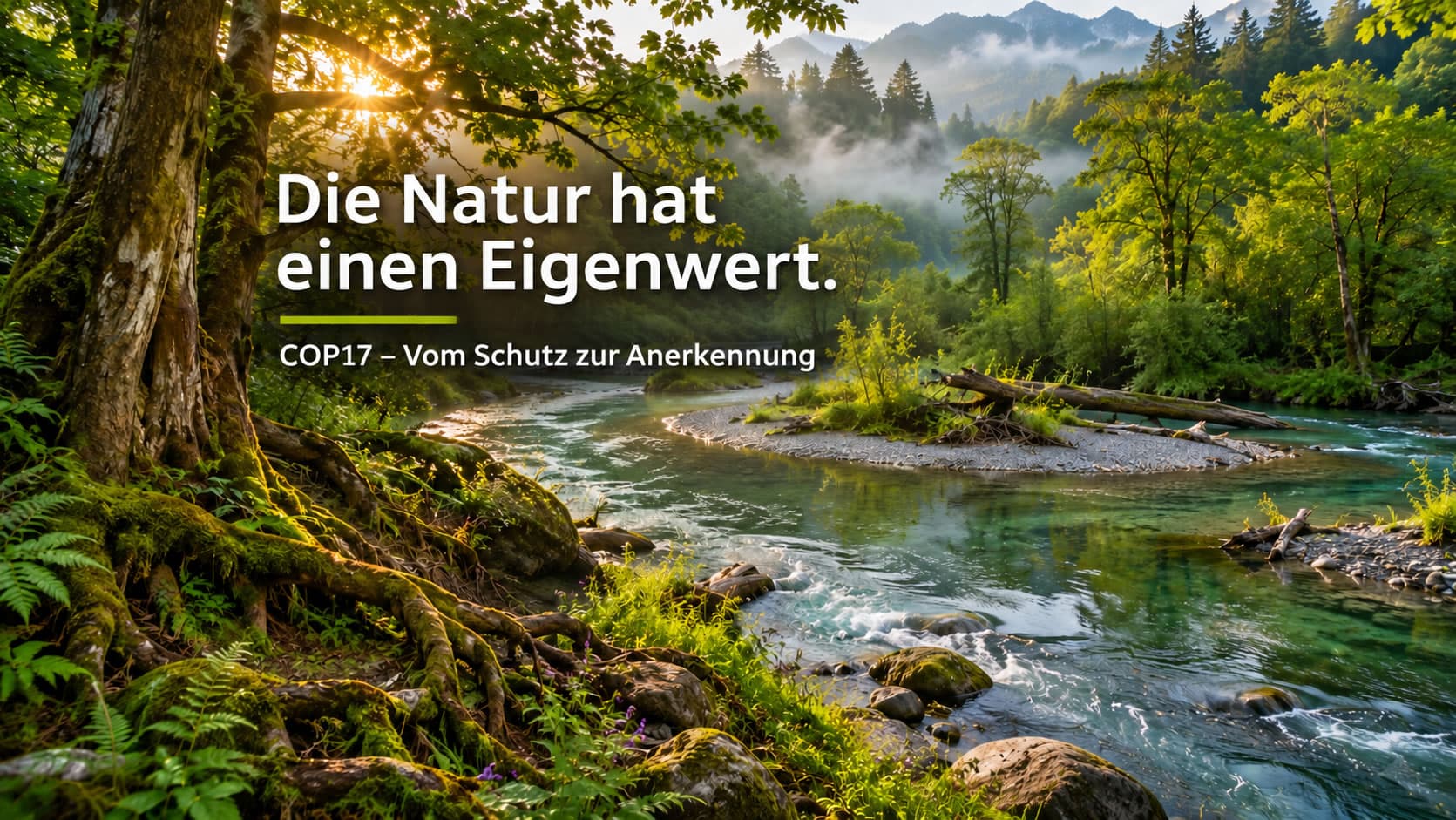
A river does not become a river only when a public authority considers it worthy of protection. A forest develops through intricate relationships among living beings, soil, water and climate. Its independent existence does not depend on human recognition.
That existence alone, however, does not logically establish a binding moral duty. A normative claim to respect requires an additional ethical argument: for example, that autonomous life, vulnerability and natural development deserve moral consideration beyond their usefulness to humans. This is open to philosophical debate. Precisely for that reason, the claim should not be presented either as a scientifically proven law of Nature or as a legal rule already in force.
Rights of Nature therefore do not begin in a courtroom. They also concern how we understand our relationship with the living world and how that understanding shapes political and legal decisions.
From normative claim to positive law
An ethically grounded claim differs from an enforceable subjective legal right. State duties to protect, legal personality, statutory representation and standing to sue are also distinct legal mechanisms. They may operate together but are not interchangeable.
International developments show the diversity of approaches. CBD decision 16/35 invited the United Nations Environment Programme (UNEP) to continue exchanges on Rights of Nature, taking account of countries that recognise such rights. An information note prepared jointly by UNEP, IUCN-WCEL and UNDP explains different approaches. It presents Rights of Nature not merely as another legal framework but also as a potential catalyst for changing social values and public decision-making standards. An information note is not a binding rule of international law.
Spain offers an example of enacted law: Law 19/2022 recognises the Mar Menor and its basin as a legal person, with rights to exist, develop naturally, be protected and be restored. It also establishes arrangements for representation and public responsibilities. Whether this recognition has already produced measurable ecological improvements is a separate empirical question.
Another reference is Advisory Opinion OC-32/25 of the Inter-American Court of Human Rights, issued in 2025. It addresses Nature as a subject of rights and state duties of protection and restoration. The relevant holding on Nature's status as a rights-holder was adopted by four votes to three. Climate-related protection duties were formulated unanimously. A further narrowly adopted proposition concerning certain gravest harms to planetary ecosystems as violations of peremptory international law remains contested. The opinion does not impose a directly applicable obligation on German authorities to recognise Nature as a legal person.
Recognition is more than a litigation tool
A legal rule can change the standards against which authorities assess risks, authorise interventions or prevent damage. This concerns prevention, responsibilities, accountability and ecological relationships – not simply who can bring a lawsuit.
At the same time, legal recognition does not prove that protection has improved. We must examine whether rules are applied, whether authorities act in time and how ecosystems actually develop. Conversely, the intrinsic normative value of the natural world does not depend on whether its recognition produces immediate measurable outcomes.
Germany and Bavaria: what is actually missing?
Article 20a of Germany's Basic Law, European nature conservation law and water and conservation legislation already provide substantial protective instruments. Their scope and implementation must be considered. Enforcement deficits do not automatically demonstrate the absence of a constitutional provision.
There is also a separate constitutional-policy question: should the natural world be expressly recognised in law for its own sake? If so, which specific duties and decision-making standards should follow? In Bavaria, this is part of the debate about Rights of Nature and a possible constitutional amendment – not the implementation of a new legal mandate created by COP17.
The benchmark after Yerevan
International biodiversity policy needs funding, reliable procedures and effective action. The debate about Rights of Nature adds a different fundamental question: what place do we accord the natural world in our legal and social self-understanding?
Four levels must remain distinct: the independent existence and development of Nature; the ethical justification for respecting it; its concrete recognition in positive law; and practical responsibility for its protection. Only by distinguishing these levels can we decide clearly what Rights of Nature should achieve – and what existing law already achieves.
From recognition to constitutional development
The question of the natural world's intrinsic value is not confined to the international level. In Bavaria, an initiative seeks to enshrine rights belonging to Nature in the Bavarian Constitution.
The “Rights of Nature – Bavaria” initiative thus addresses a central question raised by this article: how can recognition of Nature's intrinsic value become a legally binding framework?
Learn more about the “Rights of Nature – Bavaria” initiative (German)
Sources and further documents
Status: 4 November 2026. This article draws on the official COP17 closing information available so far and the legal and informational sources below. The final individual COP17 decisions have not yet been fully cross-checked against their adopted texts; legally relevant additions remain possible.
- CBD Secretariat: Official closing communication on COP17 in Yerevan
- CBD: Decision 16/35 – dialogue on Rights of Nature (COP16)
- UNEP / IUCN-WCEL / UNDP: Information note “What are Rights of Nature?” – document in the source archive
- Spain: Law 19/2022 – legal personality of the Mar Menor (BOE)
- Inter-American Court of Human Rights: Advisory Opinion OC-32/25 (PDF)
- Germany: Article 20a of the Basic Law – protection of the natural foundations of life
Transparency note
These sources differ in legal nature and binding force. An information note, an advisory opinion, a national statute and a CBD decision are not interchangeable legal sources. In particular, the COP17 closing communication does not establish a general international legal obligation to recognise rights belonging to Nature.
Licence and attribution
This article and its accompanying AI-generated image are licensed under Creative Commons Attribution–NonCommercial–ShareAlike 4.0 International (CC BY-NC-SA 4.0).
Parts of the structure and wording were developed with the assistance of AI (GPT, OpenAI). Responsibility for the content: Hans Leo Bader. (CC BY-NC-SA 4.0).
Image: Created in cooperation with AI using ChatGPT Images (OpenAI) – CC BY-NC-SA 4.0.